Saturday, May 30, 2009

Death and Resurrection

A Church dies; a Church is born!
The Episcopal Church implodes.
The Anglican Church in North America commences.
Two Anglican provinces occupy the same territory.

The curtain in the temple is rent asunder again,
As schism divides worshippers into two armies of God.
One calls itself progressive; the other traditional.
Labeling their opponents revisionist vs. reasserter.

The media ascribes the split as to whether homosexual mores
Shall be accepted in all offices and rites of the Church.
Scholars say it is a struggle for truth, for the revealed Word,
As being fixed, or open to reinterpretation in changing times.

Alas, there once was a dear old church, formally known
as The Protestant Episcopal Church in the U.S.A.
We were proud that it functioned as a big tent,
Encompassing a wide range of theological differences.

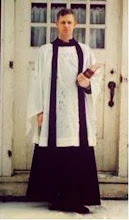
The rector of the parish was called mister,
Wearing a cassock, surplice, and stole,
Conducting Morning Prayer with its canticles and psalms.
Celebrating Holy Eucharist monthly with prayerful preparation.

We were known as God's frozen people, The Republican Party
at prayer,
The movers and shakers, the country club members.
Guilty of the great sins of pride, arrogance, indifference
and snobbery.
We enjoyed the majesty of the prayers, the beauty of the hymns,
and chatting at the coffee hour.

Wednesday, April 23, 2008

The Presence -- A science ficton tale

At the far side of our galaxy lies a planet as big as Jupiter.
We can't see it, of course, although many "exo-planets"
have been identified which surround stars that we can see.
Astronomers look for occlusion of the light temporarily
from a nearby star, and attribute it to the passing of an
exo-planet. They can even calculate the period of
revolution around the "sun" of that planet.

How do we know that an exo-planet exists that we
cannot see? From The Presence, which is its life form.
The Presence occupies its whole planet in an unbreakable
blanket similar to early microbial life on Earth. There
is no individuality, only the intelligence of The Presence
as a whole. No, he, she, or it. The Presence can monitor
living organisms on other planets, by a process we do
not understand. And has been sensing us for the very
short time that intelligent life has existed on earth. We
do not know how long the The Presence has existed.

What The Presence finds on Earth is appalling. Our
organisms are in a constant war with one another,
particularly the sentient beings. So much so that The
Presence has tried to establish a lasting sense
of goodness among us. First "they," if we may call
them that, identified a small, obscure band of nomads
in the Middle East who developed an idea of The
Presence almost four thousand years ago. However,
their actions hardly suited the guidance that The
Presence tried to communicate to them.

So they morphed into a man in the normal process of
gestation on this planet, and gave him the power
to teach their understanding of how eternal goodness
could be spread on earth. During a short period, their
representative on Earth taught all who would listen,
and performed acts of healing to demonstrate his
power.

But he was so alien in his concepts to those in
authority that they contrived to put him to death.
That would be the end of him and his disruption
of the power that they exercised over others. Then,
a few days after he was duly killed, he appeared
to people who had followed him, not as a spirit,
but as a conscious being. He was already part
of The Presence, and therefore his life could not
be ended.

He was integrated back to The Presence on his
home planet, but still he watches over us on Earth.
He tried to get us to understand, and sometimes
intervenes in our lives to get us to follow a better
direction than we could on our own. It is a fierce
struggle, one that seemingly never ends. But it
will end some day, when The Presence absorbs
those of us who have followed his teaching, into
an eternal life of love and goodness.

Saturday, November 24, 2007

Eve

Genesis 3 (NKJV)

23 therefore the Lord God sent him out of the garden of Eden to
till the ground from which he was taken.
24 So He drove out the man; and He placed cherubim at the east
of the garden of Eden, and a flaming sword which turned every
way to the tree of life.

From the National Review, November 19, 2007:

EVE

They walk to the very edge of paradise,
having already betrayed their loving Lord,
ashamed, yet willing to pay whatever the price.

They pass the Cherubim, the flaming sword,
then see the lovely world beneath their feet.
It's beautiful. But Eve knows in her heart
the sun's burning too bright in a world replete
with thorns and sweat, thistles, and dust-thou-art.

This is the battlefield, the fallen place
where Satan and his legions lie within,
in wait, with death, with every other disgrace,
within a world now indundate with sin,
she whispers, softly, "What have we done?"

by William Baer

"I see that I was mistaken about Eve in the
beginning; it is better to live outside the
Garden with her than inside it without her."
(Paraphrase) Where Eve was, there was
paradise.

From Adam's Diary, by Mark Twain


Monday, October 22, 2007

Canonical Hours

I am very fond of the Canonical Hours. Wikipedia has a lengthy
description of their development and pursuit in the various
Christian denominations. Encyclopedia.jrank.org has a more
succinct description. I edited the entry in Wikipedia under
Anglican usage as follows:

In England, the United States, Canada, Australia, New Zealand,
and other Anglican provinces, the prayer book contains:

  • Morning Prayer, corresponding to Matins and Lauds
  • Noonday, roughly corresponding to Terce, Sext and None
  • Evening Prayer, corresponding to Vespers
  • Compline
The prayer offices have an important place in Anglican history.
In the Protestant Episcopal Church in the U.S.A., now replaced
by The Episcopal Church, Matins and Evensong were the
principal Sunday services. They are in all editions of the Book
of Common Prayer as Morning and Evening Prayer. The services
often included singing the antiphons, psalms, canticles, and
responses. The clergy wore cassock, surplice, and stole, or
sometimes a tippet or academic hood over the surplice. Holy
Eucharist was celebrated once per month, and that day was
often known as Sacrament Sunday.

After Vatican II, the Anglican Communion began a dialogue with
the Vatican on common views, with an eye toward achieving
some sort of rapprochement with Rome. This prompted a move
toward using HE as the principal service, eventally resulting in
the celebrant wearing full Catholic vestments. The clergy then
began to refer to themselves as priests, rather than ministers,
and to call themselves Father rather than Mister.
The Holy
Eucharist liturgy is virtually indistinguishable from the Catholic
mass.
Morning Prayer on Sunday in The Episcopal Church is a
rarity, although sometimes it may precede HE. Evensong is
often heard with lay leadership.

Followers